Precision Gait Analysis for Dogs
See what your eyes can't: catch mobility problems early.
See what your eyes can't.
Your dog can't tell you when something's wrong until it's serious. PAWSCHECK tracks subtle movement changes over time, catching early signs of arthritis, lameness and joint disease when they're still treatable, not when they're obvious.
Ten Months of Progressive Damage Between Appointments
You Can't Fix What You Can't Measure
Even the most diligent owners only see their vet once or twice a year. That's 2 days out of 365: two brief snapshots of a continuously changing picture. Small changes in how your dog moves often begin long before a limp is visible.
of arthritic dogs are undiagnosed and untreated, seen as 'just getting old' or 'too young for arthritis.'
Annual Check-Up
Vet says 'looking good.' No visible symptoms in clinic
Weight Shifting
You don't notice - you see your dog every day
Next Check-Up
Vet says 'He has arthritis', you think 'I wish I'd known sooner…'
Ten Months of Progressive Damage in the Gap Between Appointments
Your vet isn't failing you. They're working with impossible constraints: a 10-minute window, a stressed dog on an unfamiliar surface, and no baseline for comparison. They're being asked to detect gradual change from a single frozen moment.
It's like trying to manage weight gain by standing on the scales once a year. You need the trend line, not the snapshot.
Peer-reviewed research: vets disagree on mild lameness 77% of the time, and visual assessment misses 64% of cases that instruments detect. (Keegan et al., 2010; Evans et al., 2005)
Your Dog Is Their Own Baseline
Research shows the majority of gait measurement variance comes from individual dog differences. Comparing your Labrador to some "average dog" is statistically meaningless. The only reliable comparison is your dog today versus your dog last month.
How Tracking Works
For early detection: First video establishes baseline → Every check compares to that baseline → Helps alert you to potential problems
For treatment monitoring: Video before treatment → Track response weekly → Objective data helps with treatment monitoring
For recovery tracking: Post-surgery baseline → Weekly progress videos → Share progress data with your veterinary team
Already Treating a Condition?
If your dog has arthritis, hip dysplasia, a cruciate injury, or is recovering from surgery - you need to know if the treatment is actually working. Not "seems better." Actual data.
Post-Surgery Recovery
Track improvement week by week after surgery for joint disease or fracture repair. Share objective progress data with your surgeon.
"Is she weight-bearing more this week than last?"
Medication Effectiveness
Track response to medications and physio programs. Help you and your vet team optimise your dog's treatment plan
"We started a monthly injection - is it helping?"
Chronic Condition Management
Monitor arthritis, hip dysplasia, or degenerative conditions over months and years. Catch flare-ups before they become crises.
"His chronic arthritis is well managed, but has it got a little worse this week?"
See Exactly When Treatment Started Working
Log medications, physio sessions, and supplements. PAWSCHECK correlates your treatment timeline with gait changes - so you can see exactly when improvement started (or didn't).
How It Works
Vet-reviewed gait analysis in three simple steps - at home, no vet visit
Record a 30 - 60 Second Video
Film your dog walking naturally
That's it. No vet visit. No equipment. Just your phone and 30 seconds.
We Track Movement vs. Their Baseline
We compare to YOUR dog's normal, not some generic standard
PAWSCHECK detects subtle changes in gait symmetry, stride length, and weight distribution - the same metrics vets use.
Individually Reviewed Results
Every report reviewed and checked by our veterinary team
Clear analysis showing changes over time. Simple to share directly with your dog's vet and other professionals
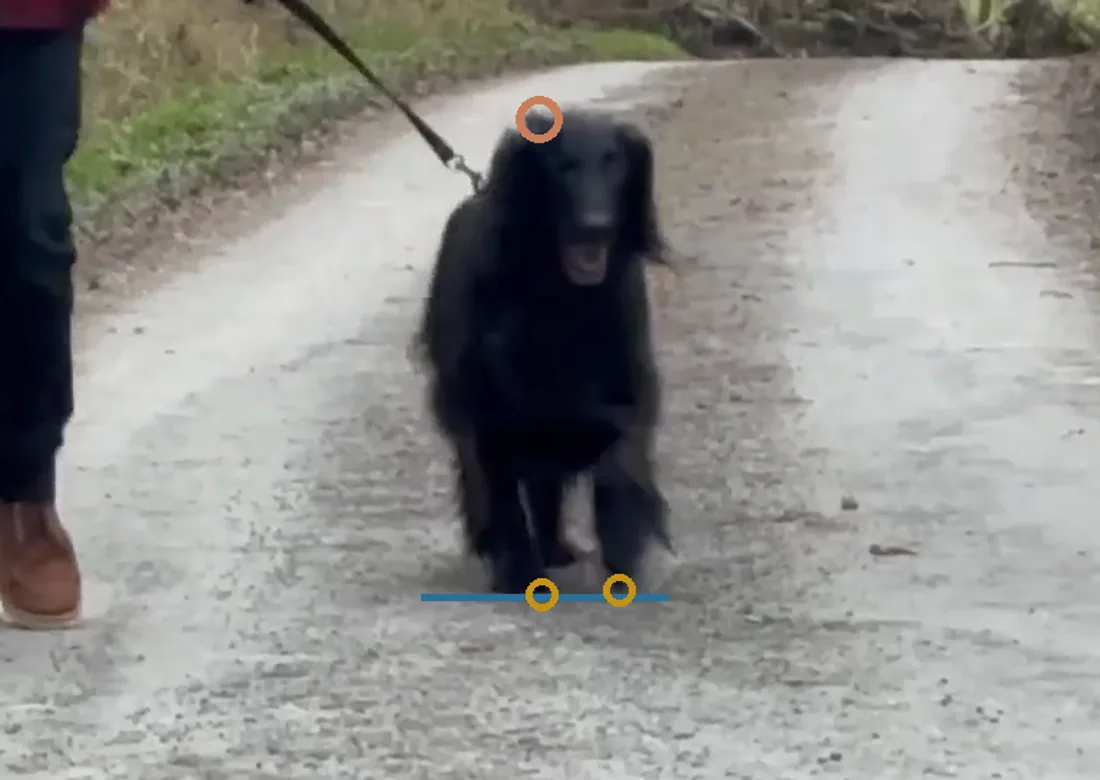
Not an impression. A measurement.
A limping dog moves in patterns too fast and too subtle to catch by eye. PAWSCHECK traces your dog's movement through every frame of an ordinary phone video — the rhythm of the stride, the rise and fall of the head, how each leg carries weight — and turns it into something you can see, compare, and act on.
- The head's rise and fall, traced beat by beat
- Stride rhythm and weight-bearing, measured across every step
- Walk and trot checked against each other — disagreement is flagged, never hidden
- Compared against your dog's own baseline
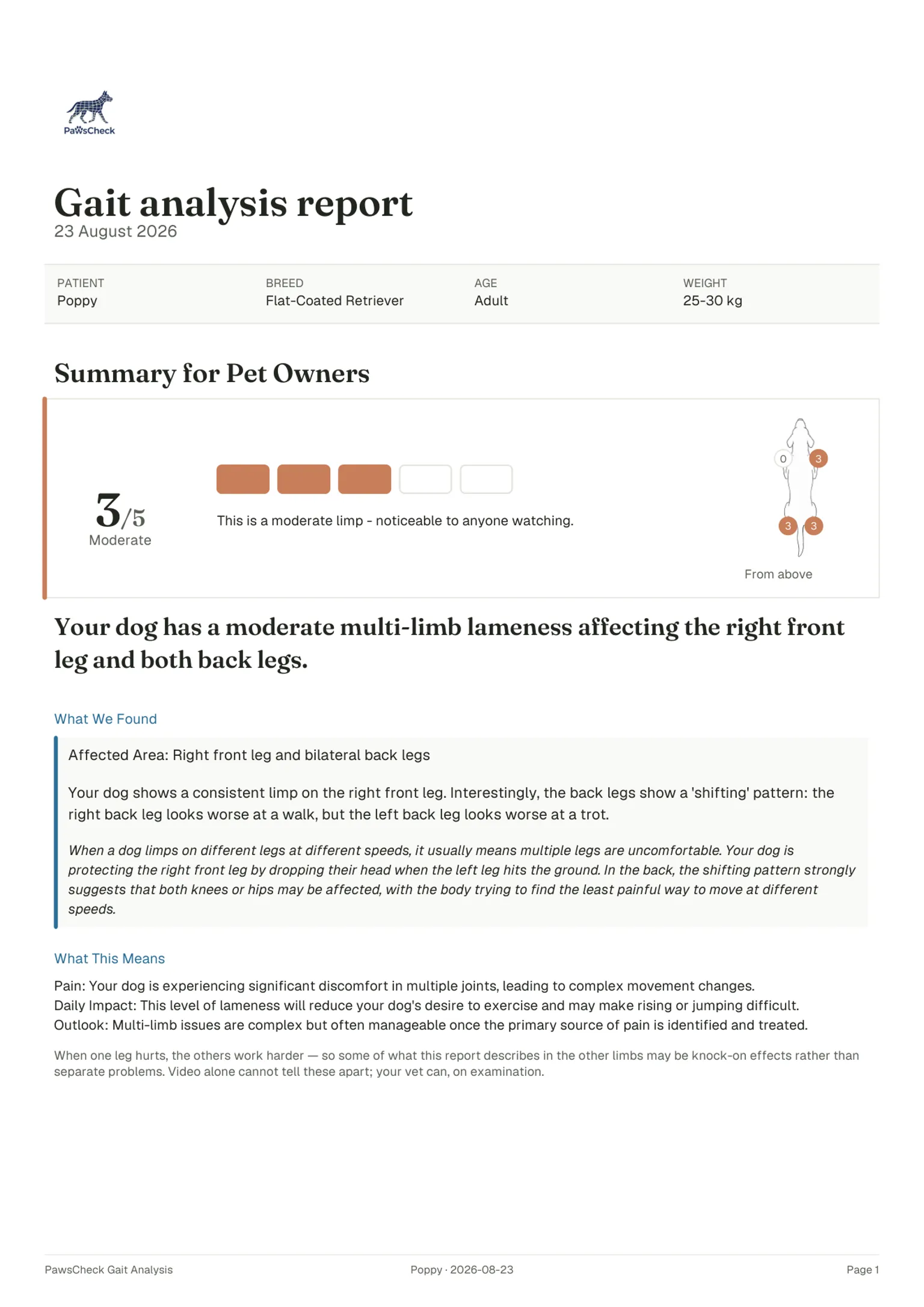
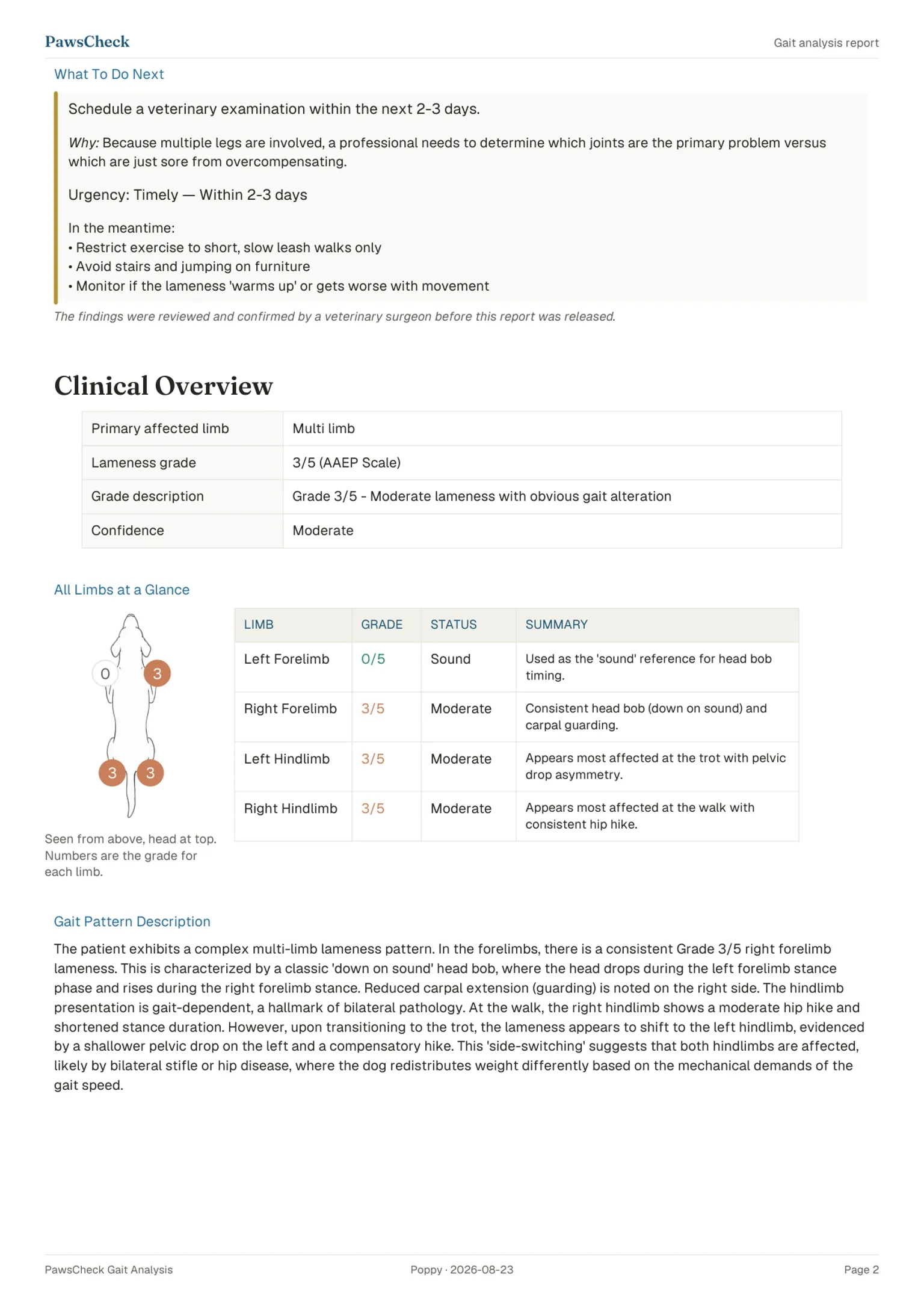
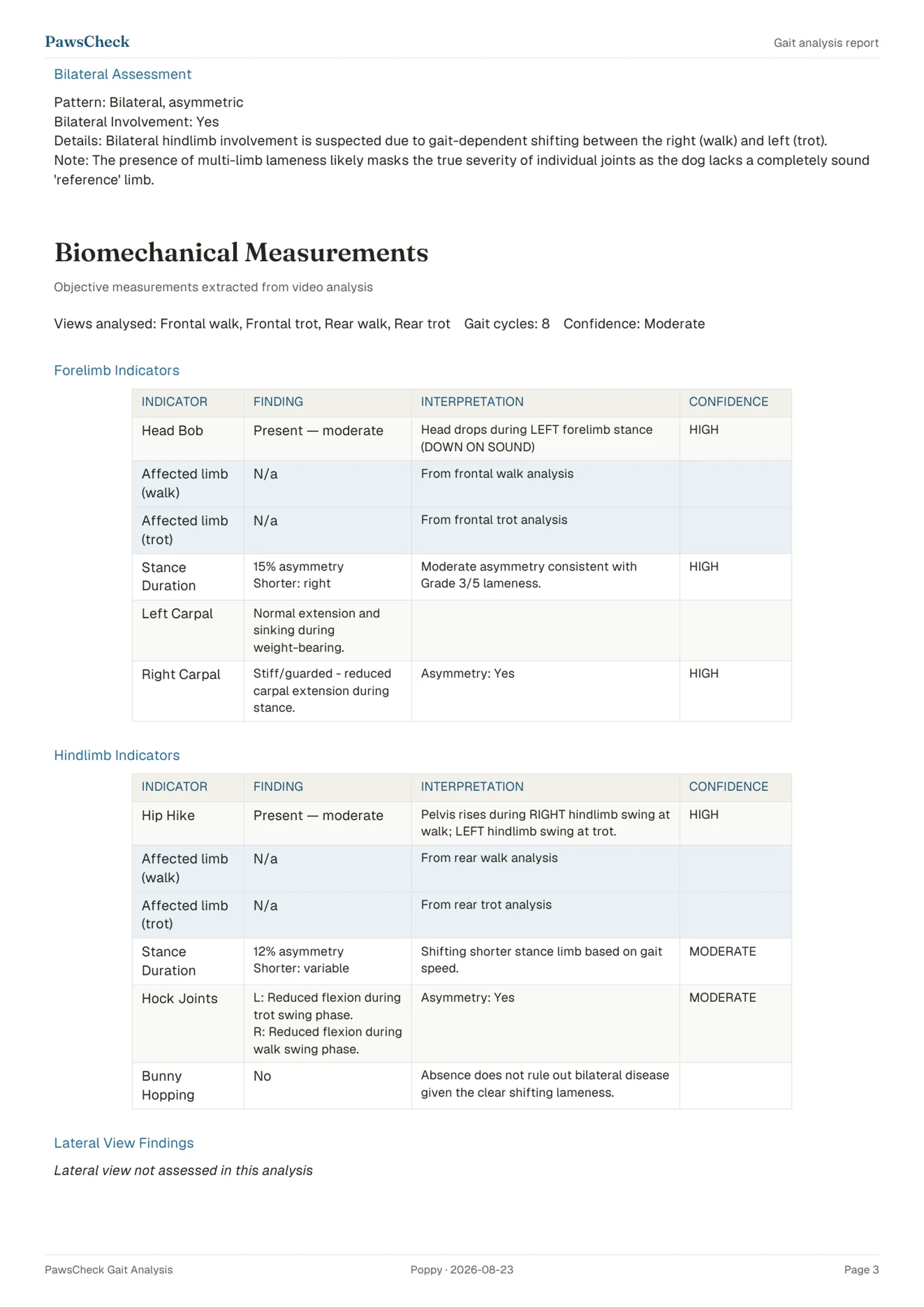
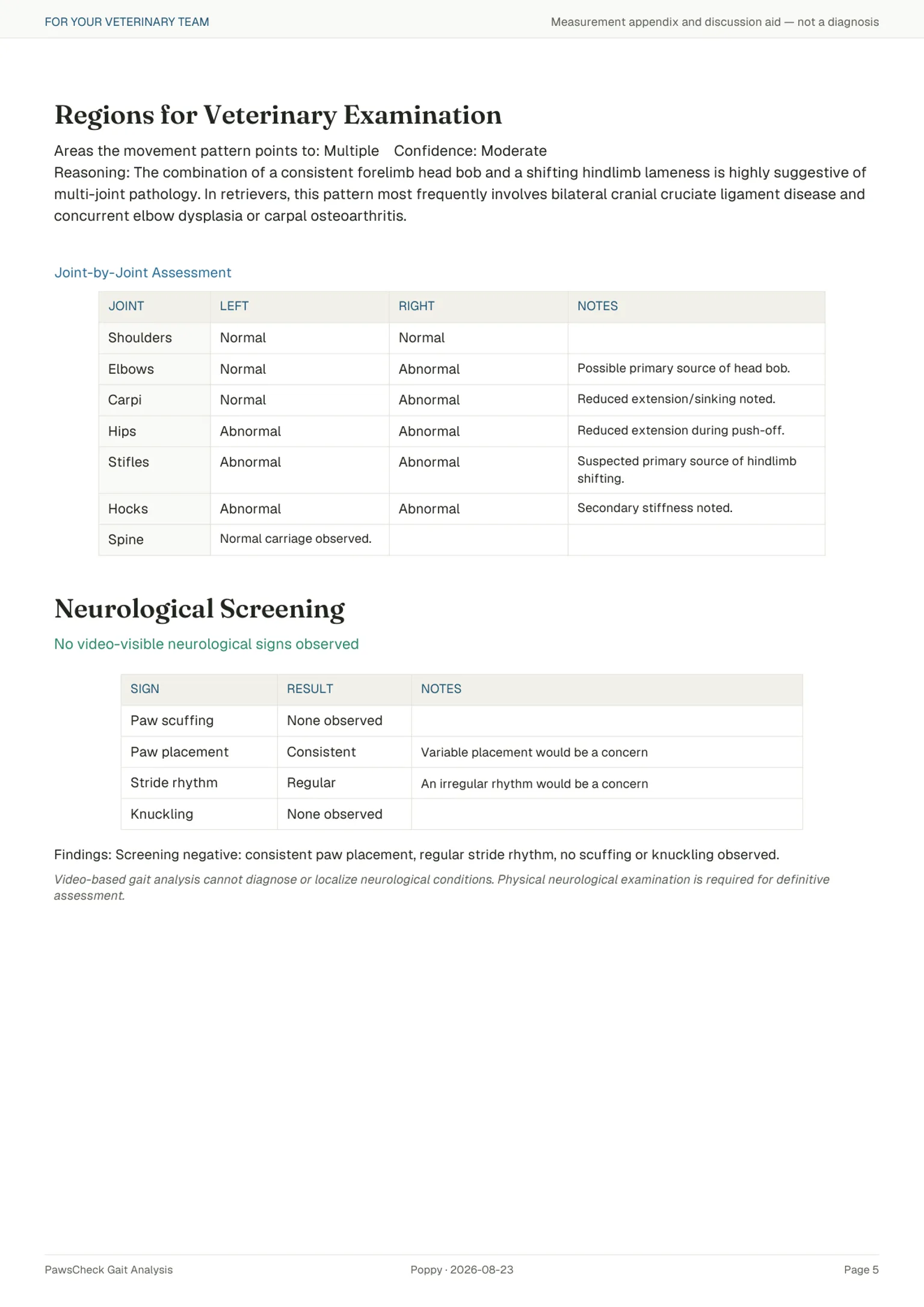
What you actually receive
Vet-reviewed, AAEP-graded, clinically detailed.
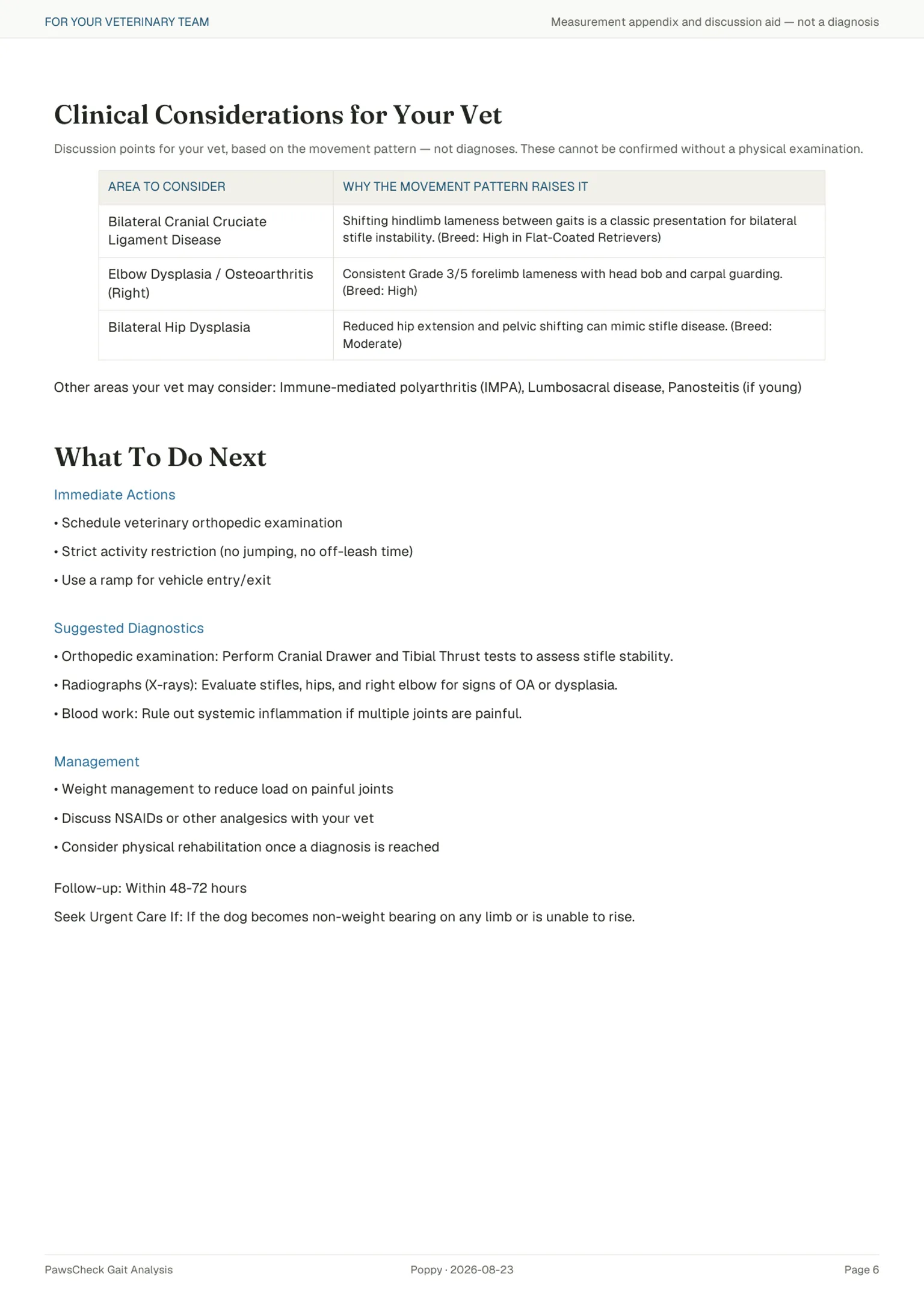
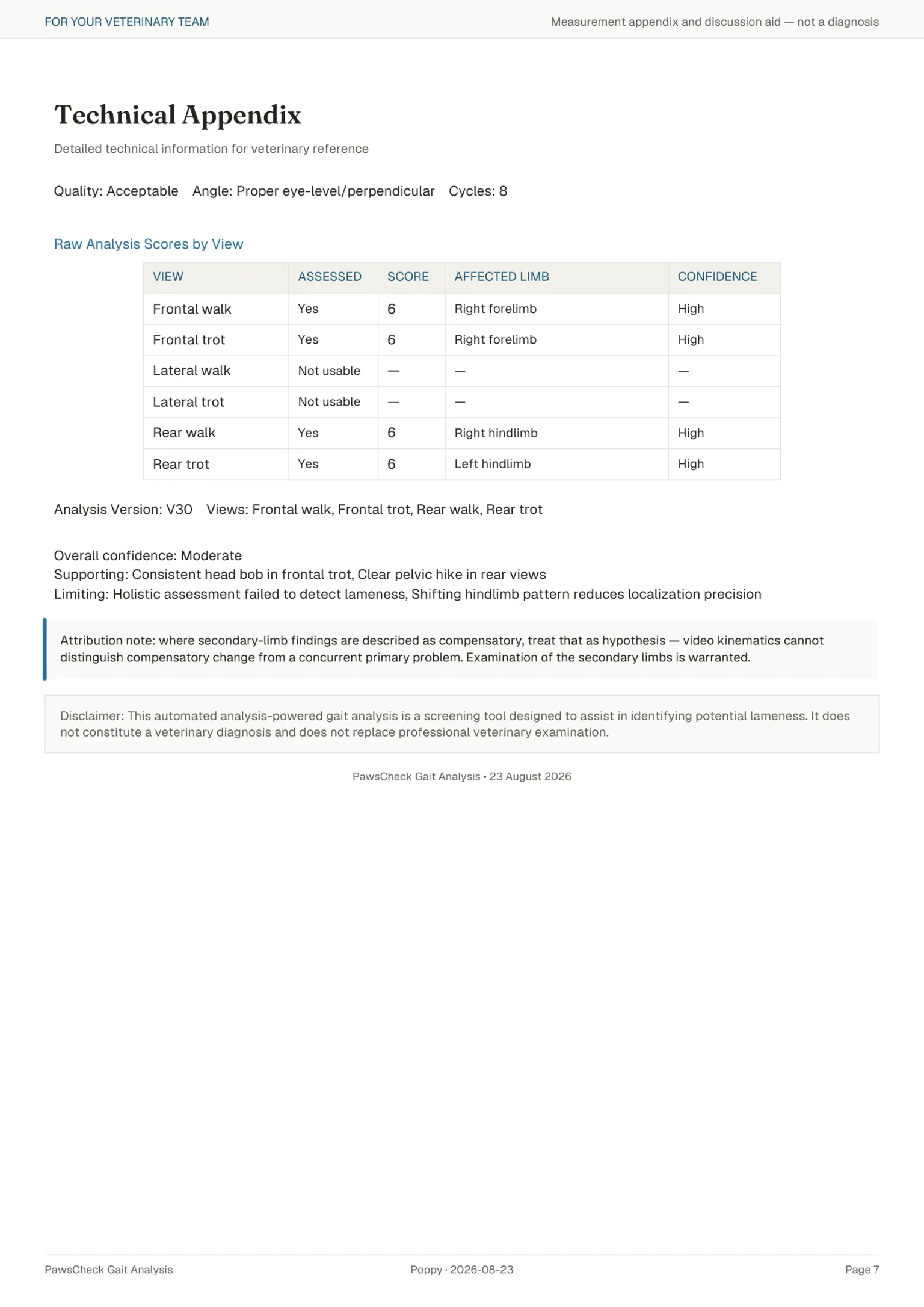
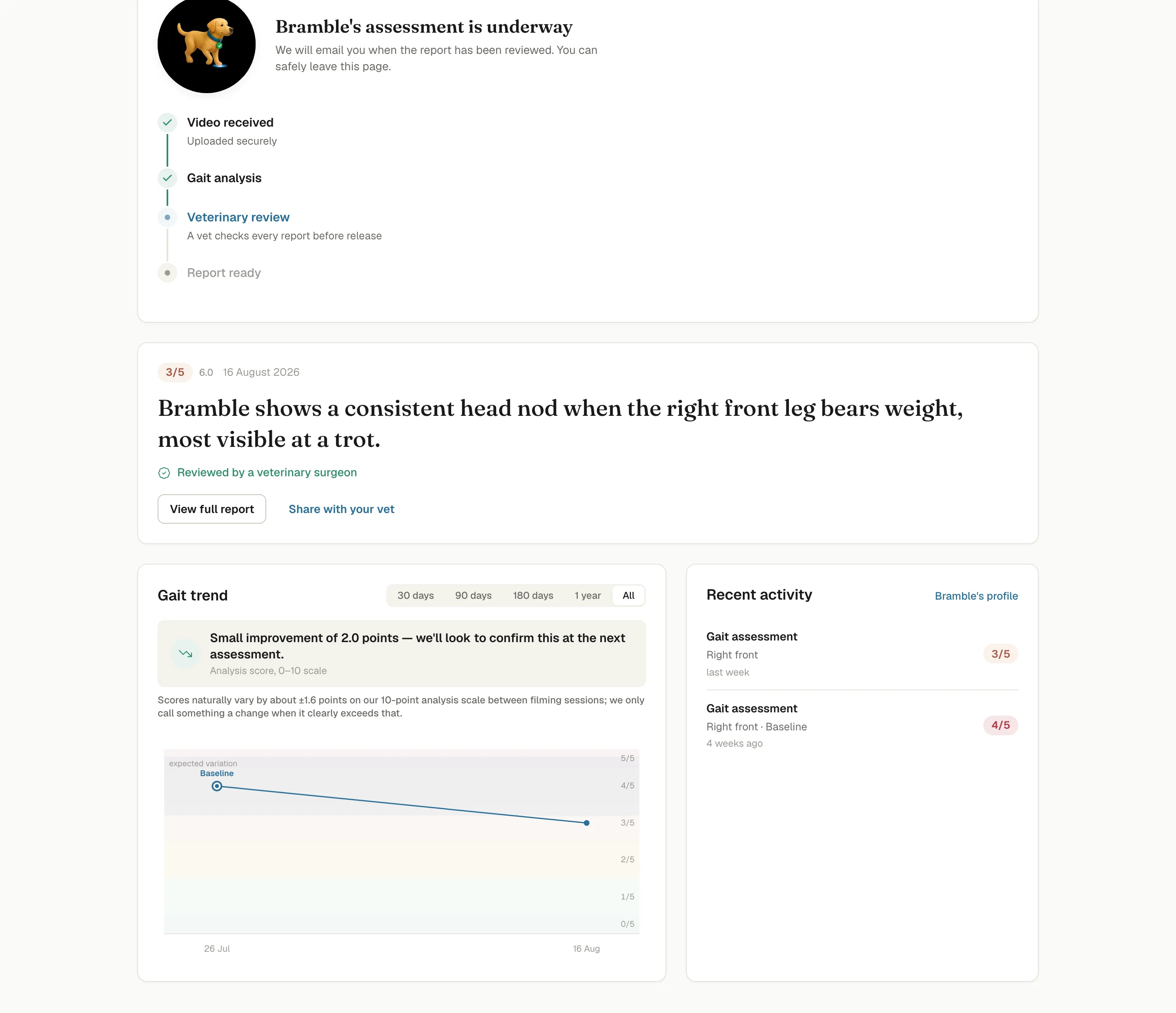
Track the trend, not just one snapshot.
Subscribers also get the PAWSCHECK dashboard: every report stored, plotted, and compared against your dog's own baseline over weeks and months.
- Lameness score over time: colour-coded gauge shows severity at a glance
- Treatment correlation: log meds and physio, see what's working
- One-click vet sharing: export every report directly to your veterinary surgeon
Why Choose PAWSCHECK
Professional veterinary knowhow meets simple smartphone convenience
Spot Subtle Movement Changes
PAWSCHECK is designed to surface small movement asymmetries that can be hard to see by eye, especially when videos are recorded consistently over time.
Vet-Developed Technology
Built by practising vets on established, peer-reviewed gait-analysis methods used in veterinary research, now accessible at home. See our Evidence & Validation page for the science and its limits.
Catch It Before It's Costly
Detect issues at the early stage - manage lifestyle, nutrition and targeted physiotherapy - instead of the late, surgery stage. Prevention is dramatically cheaper than cure
Treatment Response Tracking
Log medications, physio and supplements. See exactly when and whether strategies started taking effect
Your Dog's 'Today' vs Their 'Yesterday'
Every dog is unique. We compare your dog today against their own baseline - not a generic "normal dog" that doesn't exist.
Home Environment = True Baseline
Only your vet can make a diagnosis but in the meantime, no waiting for an appointment, no stress. Just record a quick video on your phone and get professional-grade analysis where your dog is comfortable. Returned within minutes
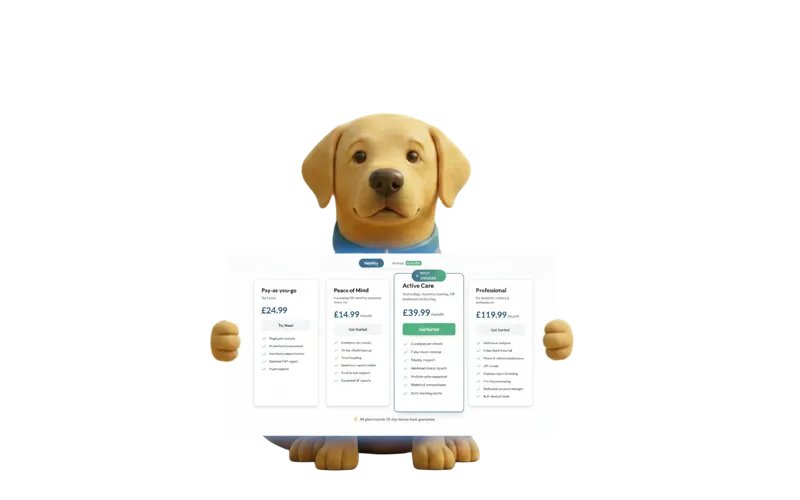
Simple, Transparent Pricing
Choose the plan that fits your needs.
Pay-as-you-go is available today. Monthly plans launching soon: 2-month minimum sign-up, then rolling monthly. Join the waitlist for priority access.
Pay-as-you-go
One-off scan, no commitment
- Single gait analysis
- Veterinary report review
- Detailed PDF report
- Email support
Peace of Mind
Single dog, monthly monitoring
- 1 analysis per month
- Trend tracking
- Veterinary report review
- Email support
- Download all reports
- Need extras? Top-up credits available: 2/£60, 5/£135, 10/£250
Active Care
Multi-dog households OR closer monitoring of one dog
- 2 analyses per month
- Use across multiple dogs in your household
- Enhanced trend tracking
- Download all reports
- Need extras? Top-up credits available: 2/£60, 5/£135, 10/£250
Professional
For physiotherapists, trainers & behaviourists
- 5 analyses per month
- Multiple clients supported
- Custom report branding
- Priority processing and support
- Dedicated account manager
- Enhanced trend tracking
- Download all reports
- Need extras? Top-up credits available: 2/£60, 5/£135, 10/£250
All subscriptions: 14-day minimum gap between scans of the same dog · 2-month minimum sign-up, then rolling monthly.
"But What If..."
Real questions from dog owners who care about getting this right.
Still Have Questions?
Our team is here to answer any questions so you can get on with using PAWSCHECK to help the canine members of your family.
Contact SupportA person signs every report
Nothing reaches you until a veterinary surgeon has reviewed the findings against your video.
Change beyond the noise
Scores naturally vary a little between filming days. We only call something a change when it is bigger than that natural variation.
Mild means mild
Grades follow the standard veterinary 0–5 lameness scale, and a subtle finding is reported as subtle — never inflated.
Trusted & Secure
Your dog's health information is protected
Developed by Qualified Veterinary Surgeons
Created by veterinary professionals with decades of combined experience in canine orthopaedics and gait analysis.
UK GDPR
Built to comply with UK and EU data protection law. Your data is stored on Google Cloud with safeguards for any international transfers.
Encrypted
Your dog's health information is encrypted in transit and at rest.
14-Day Money-Back Guarantee
Full refund on a one-off assessment if you cancel within 14 days and we haven't yet delivered your analysis. See our Terms for subscription details.
Notice the Changes You Can't See
Movement often changes long before a limp is visible. Regular measurement helps you and your vet spot those changes early and make calmer, better-timed decisions.
Start Tracking Today